1. Understanding Event-Driven Architecture
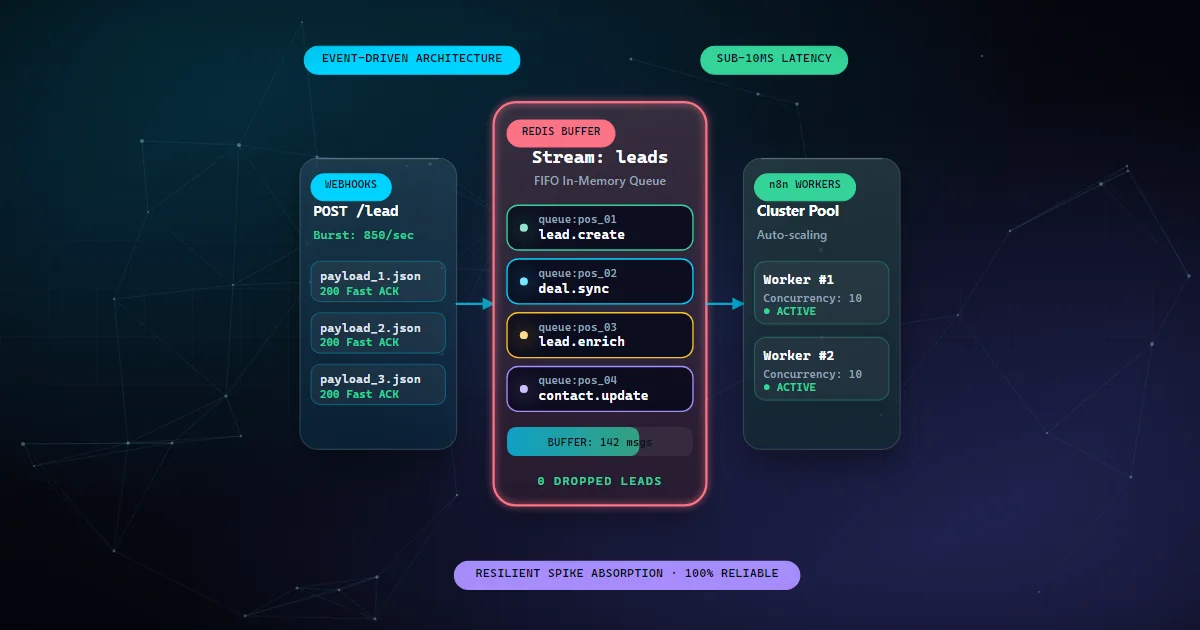
Event-driven architecture is a design paradigm where the system responds to events or changes in state. This approach is particularly useful in applications where real-time processing is crucial, such as lead management systems.
2. Setting Up Redis for Queue Management
Redis is an in-memory data structure store that can be used as a message broker. Setting up Redis for queue management involves configuring it to handle high-throughput events reliably.
docker run --name redis-queue -p 6379:6379 -d redisThis command launches a Redis instance, ready to manage your webhook queues.
3. Integrating n8n with Redis
n8n, a powerful workflow automation tool, can be integrated with Redis to automate and manage incoming webhooks. The integration ensures that each event is processed without loss.
To connect n8n to Redis, configure your n8n instance to listen to Redis queues and process events.
4. Designing Reliable Webhook Workflows
Designing webhook workflows involves creating reliable triggers and tasks in n8n that respond to events in real-time. This includes setting up error handling and retries to prevent lead loss.
For example, a workflow can be built to handle a failed webhook call by retrying the event after a short delay.
5. Monitoring & Optimizing Performance
Monitoring the performance of your event-driven architecture is crucial. Use Redis monitoring tools and n8n's built-in analytics to track the performance and reliability of your webhook processing.
Regularly review logs and performance metrics to identify bottlenecks and optimize your setup.